
Tenacious ME
Tackling disabling autoimmune disease with obstinance and humor.
What Your Loved One With Rheumatoid Arthritis Wants You To Know
One of the most frequent troubles Rheumatoid Arthritis (RA) patients struggle with is being understood. If you don’t have RA, it is a little hard to imagine what it is like. The morning stiffness that sometimes sticks around all day. The painful swollen joints, the deep fatigue, the stress of finding treatments that work and the load of side effects that often come along with treatment, make for a complex life. A life that is often also lonely as mobility becomes a challenge. Loneliness that is even deeper when friends and loved ones do not understand what they are dealing with. We polled hundreds of rheumatoid arthritis patients to find out what they wish their loved ones understood about RA. Here are a few things your loved one with Rheumatoid Arthritis wants you to know.
It isn’t arthritis
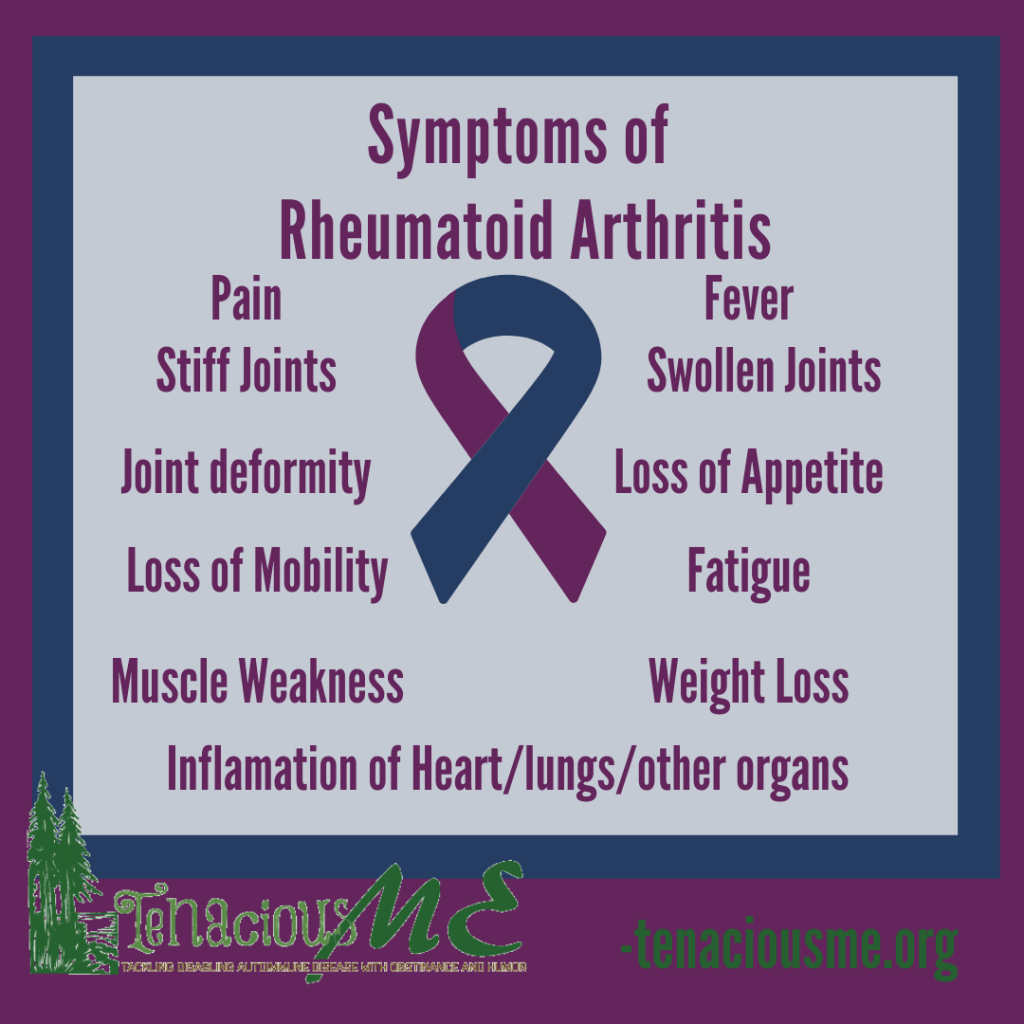
A common misconception due to the name and a general lack of knowledge about the disease, Rheumatoid Arthritis is much more than arthritis. While stiff joints, joint pain, and joint deformities are indeed a big part of how RA shows its teeth, that is far from the only area this autoimmune disease impacts.
RA is a systemic disease; this means that it attacks the entire body. Heart and lung tissue, tendons, eyes, vocal cords and muscles are also on the possible hit list for RA. It brings with it increased risk of cardiovascular disease, lung disease, various forms of cancer, wasting sickness, blindness and so much more. Unchecked, Rheumatoid Arthritis is deadly.
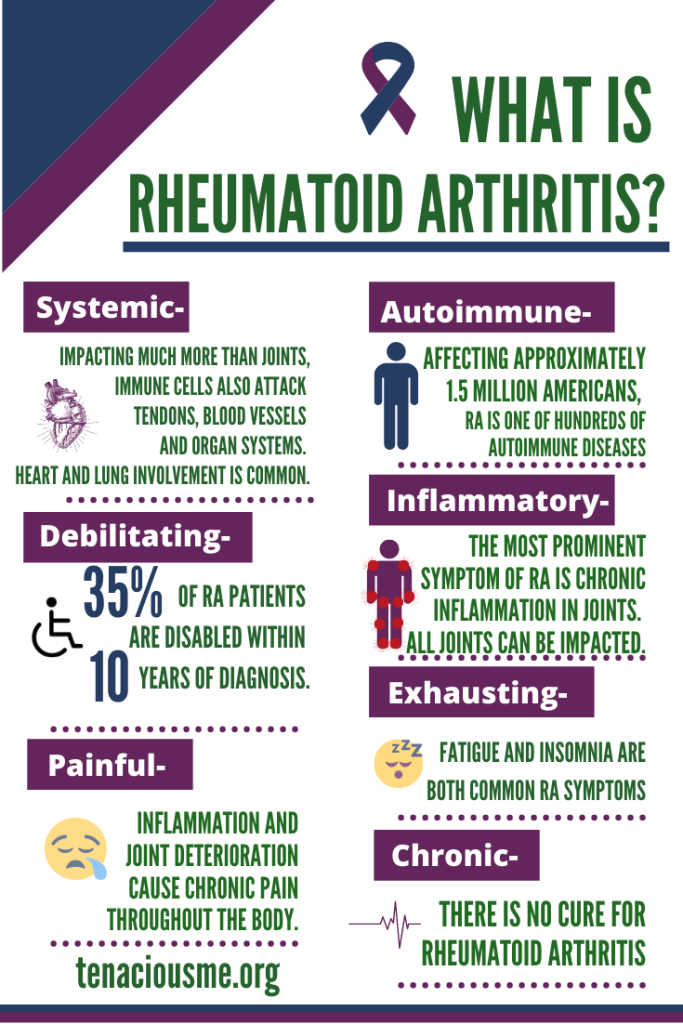
Managed, it is still chronic. The most common and persistent symptoms of disease activity are pain, stiffness, fatigue, depression, and brain fog.
Treating RA is complex, frustrating, and frightening
Fighting a chronic, debilitating disease like RA can sometimes feel like a full-time job. Medical appointments, treatments, diet and exercise regimens to keep the disease in check often dominate the lives of patients. Because even among professionals, there is a great deal of misunderstanding about the scope of the disease, patients often have to fight for the medical care they need. Successful management takes a team of professionals including rheumatologists, orthopedic doctors, physical therapists, massage therapists, psychiatrists, and various other sorts of doctors when heart, lung, eyes etc. become impacted.
Medical treatments involve medications that shut down various immune reactions, leaving patients vulnerable to a host of issues. (If your loved one with RA cringes when someone in the room sneezes, this is why!) Frequent battles with infections and microbes are par for the course.
The possible list of side effects on these medications include increased risk of cancer, nerve damage, liver failure, kidney failure, hair loss, weight gain, fatigue, blood sugar abnormalities and even destruction of bones. Treating the disease often feels as dangerous as letting it do what it will. Patients are forced to choose which side effects and symptoms they can live with, and to hope none of the ones they ignore kill them in the end.
There is no one treatment that works for all. It is all a process of trial and error. Unlike many of the symptoms humans commonly face, there is nothing that eliminates symptoms for everyone. Every body responds differently to treatment. It quickly starts to feel like a game of medical roulette, will this help, or will it destroy a vital organ? Only time and trial will tell.
There is no one treatment that works for all.
This medical mystery and frustration is doubled when faced with those who, with the best of intentions, fill them with false promises of miracle cures. The fact is,
There is no cure
Knowing all the dangers associated with active RA, you’ve likely poked around online, talked to friends, maybe even health professionals, about how your loved one could feel better and be safer. Probably more than a few have suggested diet, exercise, herbs, various medications and supplements, all with promises to cure Rheumatoid Arthritis.
Something that you really need to understand and come to terms with is THERE IS NO CURE. This disease is chronic, it is not going anywhere. While it is true that many of the recommendations will make life with Rheumatoid Arthritis and disease management easier (If you consider restrictive diets and piles of supplements easy), none of those things will ever cure RA.
Once it is activated, there is no stopping it. The best any medical treatment or natural approach is likely to do is slow it down. In a small percentage of patients, times of “remission” may occur. Some are even able to stop medications and continue to be in remission. These cases are few and far between, and so far, none have lasted. RA always flares up eventually. Even on the most restrictive diets. Even when you do yoga daily. Even on medications with terrifying side effects.
So, while they appreciate that you want to help them feel better, please keep that miracle cure to yourself. They have heard it all before, they have probably tried it all. They are doing their best to manage their disease. What they need from you is understanding and support, leave the miracle cures to strangers on the internet. Trust me, they will get that little tidbit somewhere, and they won’t be annoyed with you for suggesting kale can cure RA.
They want to be able to do it all, they just can’t
Probably most important thing for you to know is that they are still the same person they were before RA came calling. They have the same dreams and desires, love the same activities, and truly want to live the life they lived before diagnosis. Sadly, quite often that life quickly becomes out of reach as managing RA and all the physical challenges it brings, forces them to change their lives.
They don’t have the same stamina, the pain wears them out, their bodies don’t function like they used to. Its more than pain, its debilitating muscle weakness, exhaustion, and remodeling joints. Whenever you feel annoyed that your bestie just can’t now, imagine how badly she feels about that.
Imagine you woke up tomorrow barely able to shower and dress yourself. Still think they need to just suck it up and go out with you anyway? Imagine you also woke up to find out you’d been injured by a hit and run driver in the night. That is life with Rheumatoid Arthritis.
What they can do today, they might not be able to do tomorrow (and it frustrates them more than you)
Perhaps the most challenging aspect of managing autoimmune diseases like RA is the way symptoms can change so much from one day to the next, or one end of the day to the other. Pain and inflammation flares and calms in sometimes completely unpredictable cycles. A knee that works perfectly in the morning may be stiff and useless by afternoon.
To an outsider, not living in a body that can now and truly can’t later, it is hard to imagine why rheumatoid patients cancel plans when they do. Yesterday you saw them at the gym, and they were fine, it is easy to understand why you find their claims that they can’t walk today suspect. But this is the reality of life with RA.
When they say they can’t, they mean it. Believe them and try to be sympathetic. They wanted to join you, they really did plan to enjoy that day out, but they are not in control of when they can and when they can’t. They live their lives at the mercy of unpredictable bodies.
The fact is, cancelling plans disappoints them more than it disappoints you. They do it all the time and its never because they don’t want to leave the house. They have cancelled dinners, dates, shopping plans, medical appointments, days of work, showers, projects they wanted to do. The list of times they have felt the guilt of cancelling because they woke up in a flare are endless. It makes them feel weak and useless. They never feel as though they are in control. It is unimaginably frustrating. Let them know you understand their frustration, be disappointed alongside them, not disappointed in them. They have the self-disappointment covered.
Everything is more challenging than it used to be
It is hard to imagine life with RA unless you’ve lived it. A systemic disease, it impacts every aspect of life. Unlike the more common Osteoarthritis that comes with wear and tear as we age, RA can impact even the least used joints in the body. Joints you don’t even probably realize are joints.
It does so in a very chaotic manner. There is no real rhyme or reason to what it hits and when it hits. Inflammation can pop up at any time, leaving joints swollen, hot to the touch, stiff, and painful. Anywhere in the body. From jaw hinges to the tiniest of toe joints, any body part can suddenly become useless and painful to attempt to move. This causes every aspect of life to become a challenge.
From brushing your teeth to walking out the door each day, you move a surprising number of joints. Imagine if each of them felt as though they were welded shut. If you’d like to see what that is like, take a long rope, wrap it around your dominant hand so it cannot open all the way, now, wrap it around your elbow, then secure it to your waist. Be sure not to leave enough slack to raise your arm. Now, go ahead and get washed and dressed. Did I mention that you also cannot reach your feet today? Hope you have slide on shoes and don’t mind going without socks, otherwise you better leave 30 minutes to figure out how to get those feet dressed. If you had RA, all those restrictions would also be punctuated by pain.
Since we are getting dressed, let’s take a look in that closet for a minute. Remove every item with buttons or snaps. Hands ravaged by RA, the number one symptom of the disease, cannot manage buttons and other fine motor tasks. Many an RA patient has made the mistake of struggling to button their pants only to find themselves unable to unbutton them at the crucial moment. Yes, sometimes we pee ourselves, trapped in pants we cannot undo. There is nothing much more humbling than being trapped in pee soaked pants. So, let’s just remove those from the wardrobe. Also, remove anything with a small zipper pull, also a fine motor skill, zippers are another great way to become trapped in your own clothing.

Next, let’s take a good long look at that collection of shoes. Remove anything that ties, you can’t reach the laces. Heels are a no, your toes won’t tolerate a heal of any height, toss those to the side. Because your feet are going to swell, and may already be changing shape, also get rid of anything with a narrow toe, pointed toe, or slim instep, you’ll never get them on. How’s the shoe collection looking now? If you’re anything like I was when diagnosed, you’re down to a couple of pairs of clunky slip on shoes. Did I mention you’re attending a wedding this afternoon? Fantastic.
Speaking of weddings, let’s move on to accessories. See that collection of pretty hair ties, barrettes, clips and other things to add a little flair to your hair? In the bin it goes. Don’t worry, the hair will go soon enough, either because it is falling out (a symptom of RA and also a side effect of many RA medications) or because you can’t brush and wash it so you’ll get it cut short and manageable. Speaking of manageable, that jewelry box full of necklaces and bracelets with tiny clasps? Save it for your grand kids, give it to goodwill, you can’t put it on. Same for rings, with fingers that swell when they want to, rings are another great way to get stuck. If you don’t want to have it cut off later, leave it in the box.
At this point, you likely have a massive pile of things you can’t use anymore. Among them, likely some of your favorite things. Frustrated and sad? Welcome to life with RA. That was only what changed in the area of personal care. Notice we never even entered the kitchen or approached any household tasks.
It turns out, life with RA is full of obstacles. Literally every aspect of life is more of a challenge and many things are simply impossible without some sort of adaptive device. The world is full of doorknobs that can’t be turned, bottles and packaging that can’t be opened, stairs that make knees groan, the list is endless, obstacles are everywhere. And chances are…
They hate asking for help
Now that you’ve taken a walk in their clunky slide on shoes, you probably realize there are many times they are going to need help. So many, in fact, that chances are, they are not going to ask every time they need it. If they are stubborn and independent, they won’t ask for help a fraction of the time they need it. They also might not be inclined to let you help. Even on my worst day, I am not interested in help dressing myself. It feels too personal, too much like something a toddler could do, in short, it makes me feel incapable.

They don’t want to feel incapable. They do need help. Offers of help from you, really make their lives easier and make them feel loved and seen. It may be no big deal to you to bend over and pick up those dirty clothes they’ve been staring at all afternoon, to join them in the kitchen and offer to cut the veggies, to offer to help put on that necklace that makes their eyes sparkle. To your loved one with RA, those offers of help are offers of love. They are understanding and empathy. They appreciate them more than you will ever know. It may sometimes be hard to tell because
Pain rules their world and sometimes their attitudes
There is really nothing that alters someone’s sunny attitude like chronic pain. It is hard to be positive when you hurt literally all of the time. When all you want is a break from the constant ache of your inflamed body. It is not at all uncommon for chronic pain sufferers to lash out, become depressed, or both.
On days when pain is more intense, this can become particularly troublesome as your loved one becomes their least lovable self. Try to be patient and understanding. Know that what appears to be anger and frustration with you is actually anger and frustration at their own body. Possibly at themselves, as they beat themselves up for that sugary treat they ate yesterday, the exercise they aren’t getting and all the other little ways they might be contributing to the symptom flare.
Know that what appears to be anger and frustration with you is actually anger and frustration at their own body.
The truth is, it might be something they did, or it might not. Maybe it was that slice of cake that tipped the scale from a daily pain level of 4 to a holy shit, can we just cut my hand off now 9. Maybe it’s the weather, maybe they did too much yesterday, not enough, slept wrong, didn’t sleep. Possible triggers are everywhere, they don’t understand why they hurt, it is incredibly frustrating.
It’s also exhausting. Imagine walking around with the flu all the time. Body aches, exhaustion, brain fog, these are the most frequent and pervasive symptoms of RA. Sleeplessness due to pain and restlessness brought on by medication side effects are also a factor, as the more tired people are, the less tolerant they are of all life’s challenges.

Even good days are full of pain. It is the most persistent symptom your loved one with RA lives with. And no, Aleve doesn’t touch it. Narcotics don’t even touch it most days, not that those are an option for chronic pain sufferers, the dangers of long-term use are too high. They’re left to fight the pain with various over the counter remedies. They learn to live life in pain, to push through days and nights, hoping tomorrow will be better, as they toss and turn on a sea of pain. It is exhausting and undoubtedly increases the other most persistent RA symptom, fatigue.
Fatigue is more than feeling tired
Like chronic pain, chronic fatigue is a bit hard to imagine unless you have experienced it. I used to think it meant you felt tired a lot. I didn’t understand just how exhausted a person could feel until Rheumatoid Arthritis really reared its head. I still find it very challenging to put into words. Imagine you wake up underwater, but able to breath. Every movement feels as though you are dragging yourself through water or better yet, maybe it’s a good thick syrup. You also feel vaguely drugged, like waking up from anesthesia. You’re awake, but definitely not firing on all cylinders. If you’ve ever battled the all-consuming sleeplessness of caring for a sick newborn, imagine that had been 6 babies, and you were all alone, for weeks, that’s fatigue!
Exhaustion, brain fog, memory lapse, an inability to string thoughts into coherent sentences, all aspects of fatigue from RA. It can occur with or without proper sleep. You can sleep 10 hours a day and still feel fatigue. A kind of exhaustion that is unrelated to how much rest you get, there is little your loved one can do but hold on and wait for it to pass. While taking a nap might help a bit, they will undoubtedly wake up as tired as they are when they lay down. It’s a symptom that will go when it is ready and come back when it pleases. It is one of the more frustrating challenges RA brings to the table.
The thing they need most from you is understanding
With a life filled with challenges, fatigue, pain, insomnia, and frustration it is easy to see that what your loved one needs most from you is understanding. They are juggling a rather heavy load, they often have to drop the ball to keep moving ahead, be okay with that. Pick up those dropped balls when you can.
Watch for the things they really struggle with, offer to take them off their plate, or, better yet, surprise them by getting it done while they take a much-needed nap. Encourage them on the hard days. Take time to appreciate the things they accomplish and celebrate the good days with them. Be a sympathetic ear they can turn to when the days are harder. They often feel alone in this disease, be the one they can turn to for understanding.
Like what you read? Show me some love, give it a like, share with a friend.

HOPE
The light at the end of the tunnel.
The lifeboat that carries us to safe harbor.
The answer to a prayer long whispered.

Hope is what allows us to trudge on through the darkness.
It is the very knowing that whatever is happening now is not going to last forever that makes life bearable in the hardest times.

That hope.

It is essential to being human.

Hope carries us through the truly dark and miserable times.
Through challenges that look too big to conquer.
Through losses that tear us in two.

There with all the fear, anger, sorrow, resentment,
Always there is hope.

Sometimes the hope is so small we don’t speak of it,
for fear our words will cause it to become airborne
and float away on the breeze.
Other times it is as big and bright as a neon sign
and we find ourselves pointing it out to others,
Can’t you see that Hope?
It is breathtakingly real.

Hope is the reason the caged bird sings.
Hope is the force that gives dreams wings.
Hope asks us to take a chance.

It assures us it will all work out if we just hold on tight.
It keeps us together when things fall apart.
When lost in the dark, hope provides the spark.

Like what you read? Show me some love, give it a like, share with a friend.

Why You Need To Be Your Own Doctor

You have to be your own doctor. A phrase we have all likely heard at one time or another, until recently I thought it simply meant you need to pay attention to your own symptoms and what your body is doing and ask for a medical opinion when you know things are out of whack. I didn’t think it meant you need to literally be your own doctor. Apparently, I was wrong.
Apparently you need to be able to interpret lab results, read radiology reports, understand what you are looking at in said imaging, know all the possible side effects of everything you consume daily, and have a solid working knowledge of disorders and diseases that might pop up due to the things you know you are managing. Otherwise, you’re wandering through chronic disease unarmed, naked, exposed to all the possible dangers. Because your medical team is barely doing the job.
In my last post The High Cost of Insurance Scripted Medicine I dug into the failure to use the tools we have to solve medical mysteries. Obviously one reason to pick up that doctor hat ourselves. When confronted with what happens once testing Is complete, it becomes even clearer that the more you know, the better off you will be. What is and is not shared, when and by whom, varies a great deal from doctor to doctor. Some will go through images or blood results bit by bit, explaining what they see and why. More the norm is the doctor who presents the test results in broad strokes, not discussing the numbers but what they believe they mean. Ignoring all information not related to the question at hand.
Over the past three years that kind of medical practice has cropped up for me again and again. Being curious and science minded, I have looked at many of those reports and test results myself over the years. And I am here to tell you, sometimes what they don’t bother to tell you, could kill you. Most recently they were not telling me about low potassium, continuously low for months now, as shown by monthly blood tests ordered by my specialist. I became aware of the issue two months ago, when I looked at my metabolic panel results. My rheumatologist made me aware of it yesterday, when he asked if anyone was treating it and informed me that my heart could stop if it is not corrected. Thank you ever so much for the belated concern doc, but as the physician who orders and hypothetically monitors my monthly blood work, who did you expect to inform me and treat the issue? Perhaps more important, what else would you not feel you were supposed to tell me about if it cropped up? Kidney and liver failure? Signs of cancer or infection? Any of the other things I thought you ordered labs to check for each month? Clearly, I need to do a better job as my own rheumatologist, he doesn’t appear to have the time.
As an isolated incident such a story is no big deal really, doctors are people, they slip up, they miss things, they are, indeed, only human. Unfortunately that is far from an isolated incident, it isn’t even the only oversight he brought up at my appointment yesterday (he also was unsure if I’d been tested for something that would make my medication potentially deadly, excellent work sir, I’ll be sure to give you a great rating, not), it is simply the most recent in a string of doctors failing to inform me of what they were seeing. Information that, again and again, would have improved my health and quality of life. Information they saw and knew how to interpret. And I am not alone. People suffer due to medical oversights every day. Some of them even die. A 2016 Johns Hopkins study suggested as many as 10% of annual deaths are due to medical error. (Hopkins) That is an estimated 250,000 deaths a year.
If 10% of deaths are due to medical error, imagine how many patients survived mistakes in a given year, one would hope that would be a much higher number, but lets imagine for a moment, that ½ of medical mistakes are survivable, that would still be 500,000 people a year dealing with medical errors and the fallout from those mistakes. In our modern medical system, with well-educated professionals, endless checks and balances and medicine that is practically scripted, those numbers sound much too high. SO what in the world is happening here? Why are mistakes so common and deadly? More importantly, how can we avoid them?

The first, most likely culprit of medical error is time. If you’ve been to any sort of doctor visit this decade you have probably noticed that time is precious. The average appointment time for a patient visit is 15 minutes. That is 15 minutes in which doctor and patient are expected to cover all health concerns, treatment plans, go over medications, review test results, and decide how to proceed. Plenty of time if you are healthy, not much time at all if you are dealing with health issues with multiple aspects to cover. Appointments become a race against the ticking clock, if you don’t have questions written down, chances are you’ll be gone before you think to ask. And it is not possible to tell your physician everything in that time, so you hit the highlights and hope that is enough.
15 minutes may be enough for a coffee break, but it is not long enough to see the entire patient. Not time to consider all the different issues a patient might have. Not enough time to mention anything test results may have shown that the patient didn’t expressly ask about. The more hurried the environment, the less answers you will get. Visit an ER? You will learn only about exactly the issue you came in for. The imaging may show a massive ovarian cyst, but you are here for kidney pain, so only the stone they saw will be mentioned. This is where being your own doctor can be handy, I’ve learned a lot by looking at those radiology reports and labs later myself.
The second issue is one that precedes the fifteen minute appointment model. Doctors are rarely looking at the entire patient. When you enter their office, you are there to solve a problem, for better or worse, they will be focused on the symptoms and testing that relate to what we are seeing right now. Rarely will they have the chance to look through your patient history to put together pieces to this puzzle they have already uncovered. It is going to fall to you to drag those pieces out when you think they might fit.
At the end of the day, they are not in your body, don’t know all it has been through and all that it feels, and definitely don’t have time for a guided tour lead by your medical record. It’s going to fall to you to guide them to the information about you they need to see. If you know nothing about the kinds of things you may be dealing with, it can be really hard to know what to bring up. Once again, having some working knowledge of medicine and your conditions could pay off.

While having the time and money to pursue an actual medical degree is probably not in the cards for you, learning a bit about biology and all that you can about any conditions you are diagnosed with can help you be a better patient. Doctors may not always appreciate the way you cite the things you’ve learned on Google, and that is okay. You are not in their office to please them, you are there to get the answers you need to know about your own health. Remember, you may not be a medical expert, but you are the sole expert on your own body.
Like what you read? Show me some love, give it a like, share with a friend.

The High Cost of Insurance-Scripted Medicine

“You probably have the same virus everyone else has.” The words, coming from a trained professional, do not hold the comfort I’m sure this well-intentioned doctor means them to. She doesn’t seem to realize what I immediately understand from her statement. Her words, meant as a diagnosis, are nothing but a guess. She guesses I have a virus, just as she and other doctors have been guessing “everyone else has” the virus. The fact is, no testing has been done. Not on me, even though bacterial infections can quickly turn deadly on my medication. Common sense tells me, if I don’t fit the criteria for testing for the cause of symptoms, “everyone else” probably didn’t either. So, they guess we’re all sick from this virus they aren’t testing for.
Reality is, many of us will return, days or weeks later, sicker with the bacterial infection we had in the first place. All because medicine insists on guessing. Now, don’t get me wrong, I know there is a great deal of guessing and trial and error involved in medicine. Causes of symptoms are often hard to determine, a virus does appear very much like a bacterial infection and vice versa. This is all true.
Yet, what is also true is, we have the technology to tell the difference. A simple tissue swab can tell the difference. But, why use the tests and tools we have when we can guess, right? After all, most people will recover whether it is a virus or bacteria, on their own, in a few days. So why waste the money on testing?
The answer is millions of people like me. For those of us with compromised immune systems, the difference matters, because the treatment matters. When faced with a bacterial or viral infection, we need the right medicine to help us fight, because our immune system can’t do it alone. A fact that should be clearly noted in our charts, or at least understood based on our prior diagnosis and/or medications.

Having already tried, and failed, to alert this doctor to the fact that my medication leaves me at risk for fast spreading bacterial infections, I already know she doesn’t understand my concerns. In fact, she’s dismissed them already, having repeated to me a phrase I suspect she got from the commercial for my medication, which only mentions strange fungal infection risks. But, that’s fine, because she guesses it’s the same virus everyone else has. Sigh. This is the pathetic state of medicine in America.
We have the most advanced diagnostic tools and testing available yet insist on guessing instead of testing. A practice that is leading to pain, suffering, permanent damage, and in some tragic cases, even death. The fact is, you probably know someone who was hospitalized when the bacterial infection they visited their doctor for was mislabeled a virus and allowed to grow out of control. Or worse, someone who spent weeks in physical therapy trying to heal a body part that turned out to be fractured, broken, or torn. I know at least four such people. People who struggled and did damage to arms, legs, backs, only to find out the diagnostic Xray or MRI they needed would have determined the problem, and that such imaging would have eliminated therapy as a viable first step for recovery. People who needed splints, casts and surgery, not exercise.
So, why is this the norm? Why are doctors skipping testing that could give patients definitive answers in favor of the guess, wait and see approach? If you’ve ever asked for an alternate treatment plan I bet you know the answer. Insurance.
Insurance companies have a formula. The formula says, when a patient exhibits symptoms A,B, and C you must first try treatment X, most often the wait and rest treatment, then we will approve a test. It’s insurance scripted medicine, and it’s not working.

Millions of Americans are getting sicker, doing damage to their bodies, often permanently changing their health status and mobility. Because the doctor didn’t order that MRI, because insurance won’t pay for a shoulder MRI unless you have had this many weeks of physical therapy. It’s a numbers game to insurance companies.
We aren’t numbers, we are patients, with individual needs. Sadly, to them, we are just a statistic. Statistics say, doing a pap smear every 3 years will catch the cancer of most women early enough to treat it. Most. So, insurance will pay every 3 years. Even if you have a high risk of cervical and ovarian cancer in your family, only every 3 years, 5 if you are over 30. Because insurance doesn’t care about your personal statistics. Your risk categories and health statistics hardly figure into the picture at all.
Medicine is scripted, and many of us don’t fit the leading role. We are not statistics, we are individuals. Individuals who come to medical professionals for their expertise, expertise doctors can no longer give us unless our pockets are deep. The insurance companies hold the keys to the toolbox, leaving doctors to guess and patients to suffer.
As someone forced by my health to constantly interact with this system, who hears horror stories from so many others fighting for the healthcare they need and pay hefty insurance premiums and deductibles for, I am ready for change. It’s time to do something about the middleman, the runner of numbers and maker of scripts.
It’s time to put medicine and the tools needed to properly practice it, back into the hands of medical professionals.
Are you ready for change? Have you been injured, hospitalized, or dicked around by the system as it is? Please share your stories, leave a comment, let’s talk about what needs to change.
Like what you read? Show me some love, give it a like, share with a friend.

Daring to Dream

Do you ever get the impression people don’t believe in your dreams?
Seems no matter what it is a person dreams, there will always be plenty of people standing by ready to burst the bubble with their reality. Notice I said THEIR reality, because, no matter how sensible their objections to the dream might be, they are based on their own perceived limitations.
So, what do you do when you have a dream the majority doesn’t believe in?
You could choose to spend your time and energy trying to convince others your dream can be reality, but, spoiler alert, that probably won’t work, and it will certainly suck up energy you could be using for better things, things that will help the dream become the reality.
Dreams can come true.
Rarely does this just happen, magically, without a great deal of work.
Dreams come true because we give them life.
We give them our focus, our energy, our hope, truth, and faith that it will be so.
We give them shelter, when we ignore the reasons they can’t come true and focus on the ways that they can.
When we do these things, dreams truly can become reality.
What are you dreaming into reality in 2020? What big dreams have you already made real? Share your story in the comments.

Like what you read? Show me some love, give it a like, share with a friend.

Are You Living with Painsomnia? Pain driven sleeplessness and you.
You toss and turn, desperate for a comfortable position and much needed rest. The clock seems to taunt you as minutes turn to hours and still, sleep does not come. Not for lack of exhaustion, mind you, you are certain you could sleep for days, if only you could get comfortable enough to drift off. You get up, coat yourself in pain salves, swallow some pain pills, pray for relief, and retreat once more to the land of slumber, only to lie there, dreamless. Increasingly frustrated and angry, you eventually realize sleep is not happening tonight and give up the fight. If only you could give up the misery and exhaustion.
This is life with chronic pain.
That constant, insistent ache that makes daily living a challenge often makes sleep practically impossible. With nothing to distract from crying body parts, the pain easily becomes the mind’s main focus. You are suffering from what chronic pain warriors call Painsomnia (pain induced insomnia). If you cannot quiet that throbbing ache, sleep will not come. Sadly, far too often there is no quieting the agony. The pain is, after all, chronic, meaning always present, never leaving. You find yourself fantasizing about slumber. What you wouldn’t give for one night of restful repose. For a few hours of sleep unencumbered by constant aches and pains. For just one tranquil slumber.

The pain and sleeplessness lead you to think crazy thoughts, like how much alcohol would it take for you to pass out cold? Would the pain the next day be worth the few blessed hours of oblivion? Where could you find a doctor who would anesthetize you so you can get a good nap? The rest would be well worth the bill.
You take to the internet in those sleepless hours, seeking something, anything you have not yet tried for sleep. Sadly, you know every remedy by heart, every useless one. You’ve tried sleep meds, only to find that pain can easily break through them all, leading to an even drowsier, more frustrated you, with deeper brain fog and less patience for the rested world. You’ve used props, pillows, cozy blankets, weighted blankets, noise machines, blackout curtains (even knowing pain, not light was the problem, but desperate times call for desperate measures and the truly desperate will try anything once.) You’ve tried every natural sleep remedy on the market, from teas to tinctures, none of it has offered you the promised restful sleep.
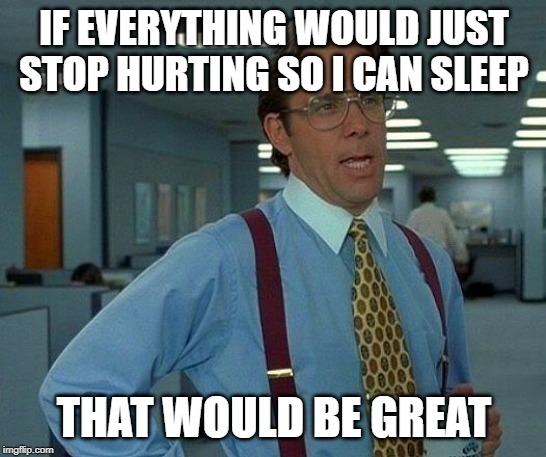
Unable to find a new sleep remedy, you search for answers for the agony. After all, it, not wakefulness, is the cause of your troubles. Without it you would surely be blissfully snoozing in your cozy, pillow filled nest. Again, you strike out, finding things you have tried, all of which have failed to bring the relief needed in the dark of night. There is something about pain in the night that makes it sharper, more annoying, harder to bear.
Perhaps it is simply that we are our most vulnerable selves in those dark hours. Perhaps it is being alone with that pain that makes it so all encompassing. It may even be as simple as not having anything else to distract us. Days are filled with things to take our mind off pain after all, but when we hit the sheets, it’s just us and that cranky body. The body we have likely pushed through the day, ignoring its distress, promising it we will rest later. The joke’s on us, it’s now later, there will be no rest.
As the sun begins to rise, your hopes turn from the sleepless night behind you to the exhausted day ahead. Maybe you can catch a nap. Perhaps tonight will be better. All you can do is hope. What gets you through the sleepless nights? Is there a sleep remedy that works well for you? Tell us your sleep secrets. We’d try anything for a little rest. Speaking of which, if you see that anesthesiologist, kindly send them my way. 😉
Like what you read? Show me some love, give it a like, share with a friend.

Making Plans with Rheumatoid Arthritis

One of the most challenging things about life with RA is how unpredictable and erratic it is. With flares often coming out of nowhere and inflammation hop scotching around the body in apparently random ways, it can be hard to predict what you can do from one day to the next. Feet that are happy today may be replaced by feet that seem to be made of shards of broken glass tomorrow. Hands that work, become swollen and weak overnight, or even from one end of the day to the other.
Sometimes the reason for pissed off body parts is easy to predict. Chances are that too long walk will result in broken glass feet and irritated knees every single time. Then again, some days it won’t. Other times it makes no sense at all and you’d never guess that riding a stationary bike would somehow piss off your hands. (My current situation, and seriously, why???)
The ever-changing nature of the disease makes it really challenging to make and keep plans. Will next Thursday be a good day for shopping with friends? Maybe. Let’s consult the weather, see what else is on the calendar that week, where we are in our medicine cycle, the moon cycle, our menstrual cycle…once you take all that into account, correct for chaos and maybe grab a crystal ball because who knows what will be mad that day? Certainly not someone with RA. It could be a great day for shopping, or it could be a day spent limping, coated in pain remedies. The fact is, it is impossible to tell, even on Wednesday night.
Sadly, few people without RA understand the variable nature of the disease, leading to a whole lot of misunderstanding and judgement. People simply cannot imagine why you are calling to cancel plans with them today when they saw you yesterday on that three-mile hike. They don’t know what it is like to have a mobile body one day and a body frozen with arthritis symptoms the next. So, they think we are flakey, lazy, dramatic, lying…we aren’t. We are simply doing the best we can to live our lives with the world’s worst house guest. One that frequently kicks our ass as we sleep.
It seeps into every aspect of our lives, ruining holidays and weekend plans, making vacation planning one giant question mark. Can we do a walking tour March 21? Let’s grab the crystal ball.

Will we be able bodied that day, or will a wheelchair be necessary? Sadly, the extremes are that big. (Try explaining transient wheelchair use to the able bodied, they really don’t get it.) So we either can the plans all together, or commit to something and hope for the strength to do it, and maybe a low enough pain day to even enjoy it. It makes that 7-day cruise with three back to back at port days look less like a relaxing island-hopping adventure and more like a shark infested obstacle course you may have to navigate completely submersed, without an air tank. In other words, impossible.

Sadly, many of us will see that possible obstacle and give up right there. Not up to facing the challenges and judgement, the stares and shockingly frequent snide comments, we choose to stay at home with our impossible house guest.
Naturally this leads to feelings…anger, sadness, feeling left out and defeated, feelings we spend way too much time with due to the nature of RA.
As I prepare for a much needed and deserved 7-day island hopping adventure myself, I am planning for good days and bad. Trying to build in rest days and telling myself I will be okay when I, undoubtedly must cancel plans because it turns out that rest day wasn’t enough. Looking at those back to back at ports and praying for three good days in a row (HA!), so I can explore new places. Making arrangements for mobility devices to be available in case I need them. Stealing myself for the weird looks and inquiries from people who saw me walking yesterday and in a wheelchair today. Hoping the loved ones I am traveling with understand my ever changing limits as well as I think they do. Knowing that the worst that can happen is I will have to spend a pain filled day laying on a beach or near the pool. Compared to some of the days my grouchy houseguest and I have spent together, that truly will be paradise.
How do you deal with the unpredictable nature of RA? Does it stop you from making plans, or do you plan and hope for the best?
Like what you read? Show me some love, give it a like, share with a friend.

Planning a Vacation from Rheumatoid Arthritis
Not really, but a girl can dream…
Some days I feel so good I almost forget about the battle happening inside my body. Today is not one of those days. Today I woke up feeling like yesterday’s birthday pinata, cracked and beaten. It seems my body is reminding me who is boss here, and unfortunately, it isn’t me. A perfect time for such a reminder as I plan a vacation adventure with loved ones. RA (rheumatoid arthritis) steps in and says ‘hey don’t forget about me.’ Oh don’t worry, I won’t, you’re coming along for the fun, whether I like it or not. I just hope my traveling companions are as willing to compromise with you as I have become.
Life with RA sometimes feels like an impossible algebra equation, with far too many factors to weigh and things to consider to predict the outcome. Will a busy day and a few drinks tip the scale from okay to why me? Perhaps, did I factor in the weather, hormones, that seriously crappy meal I just ate, and the conversation I can’t stop obsessing about? If not, the whole body seize might be surprising. To be honest, this one is not. I definitely helped create this bad day. Recognizing the part I play will hopefully help my vacation be full of more good days than bad.
So how did I get busted and battered this time? Well, it all starts with pushing back my infusion because I caught a cold. Not taking the blame for that bit, it is what it is, I had to shake the cold before stepping into the arena to knock out my immune system. Nobody wants pneumonia. So, I pushed my infusion back a week. No biggie. Okay, maybe a little biggie. Had I behaved myself, I might be just a little stiff and achy right now. I didn’t.
Instead of taking it extra easy, knowing my meds were overdue and I am just now getting over the cold I delayed them for, I carried on like normal, doing whatever I wanted. Big mistake, I do wish I could take it back.
Instead of being extra gentle with myself I just spent two busy, late nights with friends and loved ones. Days full of activity, shopping, and housework, nights filled with bad food choices and alcoholic beverages. As that pretty much describes my vacation plan (minus the housework) I’m realizing I may have to adjust the plan a little.

I’m going to have to behave and pace myself, or risk spending most of my vacation in a painful, grumpy state. Something I already knew and have thought a lot about, as I prepare to see some of the world with a fun and busy group of people. I’ve even spoken up about my limits during the planning stages, making it clear, I hope, that I can’t go all day and all night and still have a good time tomorrow. Today is my personal reminder, I also can’t eat and drink whatever I like and continue to have a good time.
Noted, all things in moderation, especially alcohol and cheese.
Today may be a bad day, but it is a good day to think about those vacation plans. A great day to plan times to rest, times to behave. A perfect day to look at that 10 day itinerary with my limitations solidly in mind. To plan down-times before excursions I know I won’t want to miss, to consider which days I might be best to take the sober friend role, and which nights I need to get to bed at a reasonable hour so tomorrow isn’t spent in a painful fog, always searching for the next rest stop, or worse, unable to leave the room.

It’s also a perfect day to look at the mobility aids I’m going to need to enjoy this trip, as my feet remind me what happens when I walk as far as I think I can. As much as I didn’t want to be, I’ll be the way too young to need a cane/walker lady everyone is staring at and maybe sometimes the chic in a wheelchair, because I’m not missing that ghost tour. Now if I could just figure out how to keep the weather stable and lovely for the entire trip, I just might get to do everything on that new, more reasonable trip bucket list.
What helps you have a good time when you travel? Do you plan for success or wing it and pay the price? What remedies and items do you bring along when you travel to keep RA symptoms in check? Give me your best travel tips, I’ll take all he help I can get.
days
hours minutes seconds
until
VACATION
Like what you read? Show me some love, give it a like, share with a friend.

Five Simple Steps To A Healthy You In 2020

It’s that time of year once again. Time to welcome in the new year and resolve to make big changes in the coming year. As you consider all the things you might wish to change, your weight, your relationship with food, exercise habits, letting go of that bad habit, I invite you to think bigger. Why chose to change one thing, when you can change everything by making a commitment to taking steps toward better health? So, skip that big resolution, and set intentions this year. Intentions for better health, for healing, for happiness. Intentions that will lead to a better you at the end of 2020. Not sure what to focus on? These five little shifts are guaranteed to lead to a healthier you.
Nourish your body
The first and most important intention to set is an intention to nourish our bodies. Please don’t run out and purchase the latest fad diet book for this. No going to extremes, no starvation, no foods you can never touch again, just a little simple shift. Take a good look at what you are eating now. Are you getting a rainbow of fruits and vegetables each day? Are you filling up on empty calories with foods high in sugar and refined carbohydrates? Don’t feel bad, most of us are, in fact, that is the standard American diet, low in essential nutrients, high in sugar and fats. Let’s shift that standard a bit.
Include fruits and veggies with every meal. Easy right? I promised it wouldn’t be tough, I meant it. Those fruits and vegetables are loaded with the nutrients our bodies need to run smoothly; resources autoimmune bodies tend to run through very quickly with all the extra side projects they create for themselves. All that self-destruction and rebuilding takes resources. Resources you can get from a well-balanced diet. Next time you reach for a snack, reach into the crisper instead of the pantry.
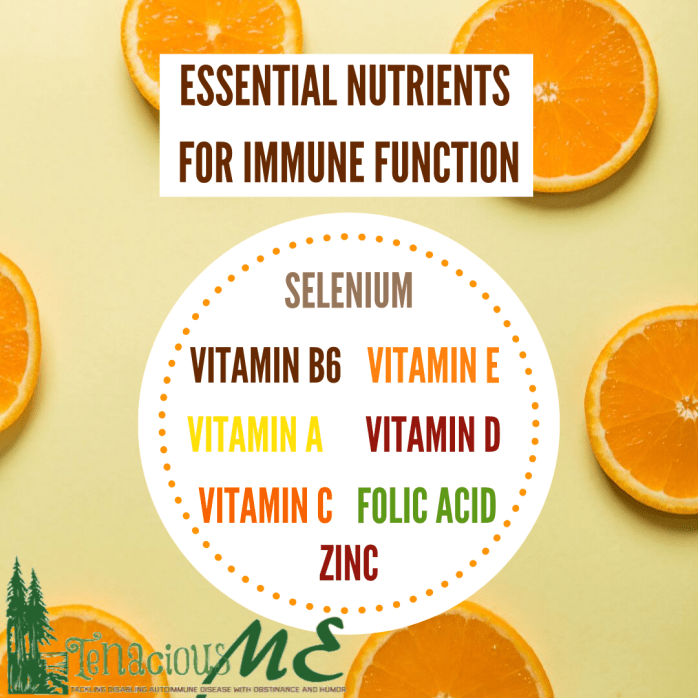
The next step we are going to take to nourish our bodies is also a very easy one, add vitamins to the daily routine. A good multivitamin, calcium, and vitamin d are all highly recommended for adults, women especially need to be sure they are getting enough calcium and its helper D to ensure bones remain healthy and strong as they age. Others that are commonly recommended for people with overactive immune systems that really burn up the nutrients are magnesium, vitamin B12, and vitamin C. All of these are essential for healthy immune system function, making them twice as important if your immune system tends to overdo it.
Be sure to always discuss any supplements you wish to add to your routine with your doctor. With your doctor’s help and a blood test to check for common deficiencies, you can better target the nutrients your body is missing.
The final step we need to take for nourishing ourselves is the easiest of them all. Drink water. So simple, yet many people do not get the recommended 2+ liters a day. Making up 60% of our body by weight, and carrying out many important functions, it is easy to understand why dehydration can cause serious problems in our bodies. Water is needed to keep cells healthy, lubricate joints, regulate body temperature, and eliminate waste from our bodies, just to name a few of its important tasks. So up that daily water intake. Skip the soda and opt for water instead. Your body will thank you.
To recap intention one, nourish your body, you’re going to do three simple things. Eat your fruits and veggies, take your vitamins, and drink water. Sound doable? Good, we’re ready to tackle the next intention, moving!
Get Moving
The second thing we need to do to have happier, healthier bodies is to commit to moving them, every day. Yes, even on the days you feel like you can’t possibly get out of bed. I know it is tempting to lay still as a statue to keep joints from crying out. Unfortunately, playing statue too often can lead to joints freezing up and holding that pose long after you are done pretending to be made of stone. Joints, muscles, and even bones require movement everyday to stay healthy and strong. Exercise also increases energy and stamina, as well as providing pain relief through the release of endorphins. So, get moving! Again, there is no reason to go to extremes here, as a matter of fact, if you have health issues of any kind, slow and steady is the way to go when it comes to exercising. No need to join a gym or even leave your bed, check out these great exercises for some ideas. Take a walk, do some yoga, chair aerobics, ride a bike, whatever floats your boat. You may be surprised how great daily movement can make you feel.

As always, check with your doctor before starting any new physical activity. Working with mobility limitations, cranky joints, and body parts that just don’t cooperate? Seek out a qualified physical therapist to help develop and modify exercises so they fit your body. So, check with your doctor, make an appointment with a physical therapist, find a few exercises you can commit to, and set an intention to move that beautiful body every single day.
Get Enough Rest
Sleeping when you have chronic pain can be nearly impossible. That is precisely why the next area we need to focus on is not sleep, but rest. Yes, this includes sleeping, but let’s face it, due to the restless nature of sleep in chronic illness, we’re also going to need to find other ways to recharge. So, we will set intentions to rest more. The first, and maybe most important thing I want you to try is sleeping when you are tired. Stop pushing through the fatigue, go take a nap. Stop putting off bedtime to watch one more episode, close those gorgeous eyes and rest when your body is asking for it. It really is the most likely time to catch a few z’s. If falling asleep and staying asleep is a challenge, you are not alone, that is the number one complaint of autoimmune patients. Check out these tips for getting a better night’s sleep.
Since sleep is elusive and we are not likely to get enough, resting during the day is going to be necessary to replenish our exhausted bodies. This does not mean crawl in bed for the day and stay there until you feel refreshed. Remember, frequent movement is really important, but so is frequent rest. Build downtime into your day. A great general rule of thumb, for every hour of activity, you need 15 minutes of recovery time. This may mean changing the way you do things a bit. Instead of doing chores or working until you are completely toast, try taking a 15-minute rest break every hour. Have a seat, drink some water, read a book, meditate, whatever helps you feel calm and relaxed. This rule applies to seated work and hobbies as well. If you spend 2 straight hours hunched over that crochet project, you will pay for it later (ask me how I know). Set a timer, take a stretch break, get up and move if you’ve been sitting. With a little bit of attention to taking breaks and sleeping when we are tired, our bodies will be much more rested and agreeable.
Ask for Help
The next intention we need to set is probably going to be the hardest to stick with. It requires a shift in how we think and behave, a combination that is never easy. It’s time to think about when we ask for help and when we don’t. Time to be honest about our needs, and that starts with being honest with ourselves. Stop pretending to be fine, you aren’t, it’s okay that you aren’t. It’s okay to let other people know that as well. Some of them deserve to know. Your family can’t and won’t help you if you never let them know you need help. Personally, this is one of my biggest roadblocks. Admitting you need help requires a couple of things that many people struggle with, being vulnerable and recognizing our limitations. Some of us are particularly bad at recognizing our limits.
Take a few minutes to write down the tasks you do each day/week. Now, split them into two lists, in list one write down all the things that are simple and achievable for you most days. In list two, write down all the tasks that are a struggle. Next, add to that second list anything you have given up doing because you just can’t, that isn’t already being done by someone else. The second list is obviously the “need help” list. It’s probably also the longest list.

Now, before you panic, thinking there is no way I can ask someone to do all these things for me, take a deep breath and relax, we’re going to break that list down a bit more. We’re going to make three lists from that “need help” list. First things first, go down through the “need help” list and move every single household chore onto a new list, the “things we all need to do” list. Unless you live alone, there is really no reason at all that these tasks should fall to only you. In fact, go back to that list of things you can do, any household chores on that list? Move them to the new “things we all need to do” list. Now go down through the household chores list and put a check-mark or your name beside the ones you can easily do, or do with a little help. Distribute the rest among the other people who live in your house. And, just like that, your life just got more manageable. Now let’s see what we can do to help get the rest of that “need help” list under control.
The next list we’re going to create from our massive “need help” list is a list of self-care tasks that we struggle with. Bathing, dressing, brushing our hair, all of these things tend to be more challenging with chronic illness. You are going to need help with some of that. Move it all to a new, daily self-care help list. Again, don’t panic, I am not about to suggest you ask your spouse to start dressing you every day! I understand more than most how much you value your independence and do not want to have to rely on others for seemingly simple things like bathing. This is where living in an age full of modern conveniences and brilliant inventions is really going to make all the difference. For every task on that list, there is a tool to make it easier. Grab that list and take to the internet, search for assistive devices for each task on the list. You’re going to be surprised how many are out there. For a great starting point, check out our gift giving guide, loaded with great tools for getting things done with limitations.
At this point, you should have your original list, a list of household chores, and a self-care list. Now we are ready to make the final list, the list of things we actually need to ask for help with. Hopefully, now that you’ve eliminated the stuff everyone is responsible for and found tools to help with the things you are responsible for, that list is going to be pretty small. Move everything not on the other lists, and any self-care task you couldn’t find a tool for to this list. These are the things you need help with ask a family member or friend, hire it out, or just take it off your plate, those are your options.
Now that you’ve thought about all the day to day stuff, it’s time to set intentions for asking for help as needed. Time to think about how you approach the bad days and consider how much being honest and asking for help could improve them. Stop pretending to be okay and putting on that brave face. Be honest. Ask for help. Say no when you just can’t. For your health and well-being. This is a lifelong battle. Don’t burn out and become disabled because you are too stubborn to recognize your limits and ask for help. Everyone needs help from time to time.
Be gentle and Kind to Yourself
The last and possibly most important intention for healing we are going to set this year is to be kind and gentle to yourself. Be forgiving of those limits. Allow yourself to be not okay sometimes, don’t wallow, there is no need to wallow, but don’t keep that brave face on all the time. It’s okay to be vulnerable. It’s okay to be frustrated, it’ not okay to take that frustration out on yourself. Allow yourself the space and understanding to be a little broken. Forgive yourself for the days when you just can’t get up and exercise. Forget the garbage you chose to eat yesterday, it’s in the past. Let yourself off the hook for all the times you’ve failed. Promise yourself you’ll do better next time and mean it. Our bodies are already attacking themselves, no sense in adding to the barrage. Treat yourself with the kindness and understanding you give those you love. With loving intention and gentle care, our bodies will be more capable of doing the things we ask them to.

With a few small shifts in the way we care for ourselves and the expectations we put on ourselves, we can make 2020 the healthiest year yet. I’m ready for a year of healing. Who’s with me? What steps are you going to take to be a healthier you in 2020? Drop your answers in the comments. Looking for support and understanding on your healing journey? Join the tenaciousWE community.
Like what you read? Show me some love, give it a like, share with a friend.

2019 Year In Review

It’s hard to believe 2019 is about to come to an end. What a year it has been! A year full of changes and challenges. I’m happy to say I tackled every last one of them! Looking back at where I was at this time last year, I see so much has changed in one short year. It has been a year of big gains and massive change. Last year at this time, I was exhausted and hobbling, limping my way through the holiday season. I’m happy to say, though I do limp a bit, I’m not hobbling anymore. Even the exhaustion, once a daily feature, is not nearly so constant and deep. It’s safe to say all the little changes I’ve made for my health have added up to big shifts in the way I feel.

I ended 2018 deeply depressed, my one resolution, to walk on the beach, had not come to pass. I missed nature, immersing myself in nature, loosing myself in a long stroll, escaping into the woods for hours, simply sitting quietly, alone, on the shore. I felt ripped off, as all of that had been taken from me. Then I realized something rather important, it hadn’t only been taken from me, I gave it up. Disheartened by my inability to walk deep into the woods, I’d stopped visiting the trees in my own yard. Unable to walk confidently on the beach alone, I’d not even set foot on the shore. I was punishing myself for my limits and it had to stop. I realized, of all the things I was missing, nature was at the top of the list. And so, I set my first intention, to spend more time connecting with the wild world, however I could. If that meant I could only walk ten feet into the woods and sit down on a stump, then walk ten feet and sit I would. I started shifting back to nature, the first stop, a long overdue visit with the old pine that lives out front. That first visit was full of tears. Tears for the time I’d lost, tears for the abilities no longer mine, tears for the path I found myself on, tears of gratefulness for that tree, standing sentinel over it all, for the grounding it gave, for the shade and the shelter.
I was punishing myself for my limits and it had to stop.
I began to remember who I was, small but mighty, inventive and adaptable, deeply connected to the natural world. I made the choice to reignite those pieces of me. To stop being sad and angry about the situation I’d found myself in and make the very best of it. To stop accepting it and CHANGE it! To stop waiting to get better and do everything in my power to be better. I gave up caffeine and the daily stomach aches it brought. Already on the highest possible dose of medication for RA, I added in many holistic remedies to help beat it back. Having previously tried managing RA with only natural remedies, then only medicine, I finally chose to blend them. How it took me so long to do that I will never know. It seems now that it was the only logical thing for me to do. After all, I AM a blend of nature and science myself. Those truly are two giant pieces of who I am. The magic of the unknown and the magic of the known. What ever made me choose? (If you guessed self-flagellation, you win a prize!)
I also stopped waiting for help. Instead, I chose to help myself. I knew what I needed, I needed mobility, I needed to walk on uneven ground. I needed to be well. So, I got loud. I stopped listening to doctors and started making them listen to me. Every bit as much as blending natural remedies with traditional ones, this changed everything. I made the decision to be heard. Two doctors, several months and three visits later, I was scheduled for a hysterectomy. Because I insisted. The doctor wanted to only take one troublesome ovary. I knew the problem was bigger than that. I really didn’t know how much bigger, or how much better I would feel until later, but I knew it was a source of issues I didn’t need to be dealing with. I also knew with all certainty that my reproductive years were behind me. So, I pushed for hysterectomy and got one. Both the doctor and my body agreed after the fact, it had been the right thing to do.

Still healing from my hysterectomy, I made an appointment with a second orthopedic about my hip. The first one had given me a useless shot and a line about being too young and being best if we can limp it along a bit longer. He was fired before I even left the office, that answer was unacceptable. So, I asked around and got a referral to the best hip ortho around. He agreed with me, the hip was ruining my quality of life, there was no reason to wait, I needed and deserved mobility now. I needed to get off crutches to save my hands. The moment he said that, I knew he was on the team for life. Anyone who’s ever seen a specialist knows just how rare it is for them to note anything outside of their specialty, the fact that he even noticed my hands proved he was rare. When he prescribed pain cream for the hands I hadn’t come to see him about and a list of herbal remedies to beat back inflammation, I realized I’d found an actual unicorn, a doctor who is open to all the possibilities and treats the entire patient. I told him I had to work around my husband’s busy season, I could have it done that month, or wait until fall. It was the first week of June. He got me on the schedule for June 28. Once again, I was blown away by the unusual care this doctor showed his patients. I was finally being heard and treated like a priority. In September, my new hip and I took our first stroll on the beach.

I definitely still have a long way to go. I’ve yet to find a doctor with an acceptable solution for my hands. But I am committed to myself in a way I never was. I know there are answers out there, I won’t stop until I find them. Meanwhile, I’ll continue this healing path I finally found. With self-love, nourishment, persistence, herbs, exercise, rest, patience, and time, I know I will be healthier and happier.
What steps did you take in 2019 to be a healthier you?


 Tenacious ME